
Overview
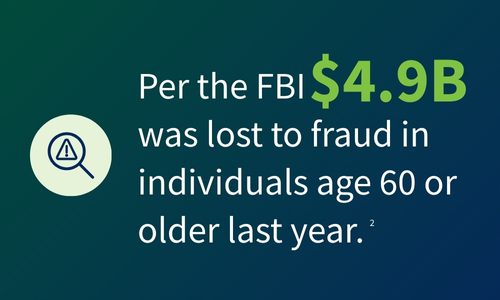
As America’s senior population grows, so does the risk of financial exploitation. Baby Boomers hold over 70% of wealth in the U.S.1 and per the FBI, $4.9 billion was lost to fraud in individuals age 60 or older last year.2 With age also comes an increased likelihood of cognitive decline, making older investors prime targets for scams or even family-based abuse. Financial regulators have listed the protection of senior investors at the top of their examination priorities for years now and for good reason, those numbers are predicted to grow.
Private Advisor Group recently hosted a panel discussion on Serving Seniors: Red Flags, Real Cases, and What Can Go Wrong to share how advisors can safeguard their clients and themselves. The session featured financial advisor Steve Cunningham of Cunningham Investments to offer true client examples; Amanda Ordemann, Assistant Vice President of LPL’s Senior Investor Protection Team; Michael Veratti Private Advisor Group’s Compliance Manager, and session host Jason McCarthy, Director of Operations from Private Advisor Group.

Best Practices
- Document all observations and steps taken.
- Confirm that a trusted contact and/or power of attorney (POA) is on file.
- Forward any doctor’s letters or cognitive assetments to compliance for review.
Recognizing Red Flags
In their full-time role, Amanda Ordermann’s team serves as a centralized resource for concerns involving diminished capacity or potential exploitation. She explained that her specialized team regularly reviews and investigates suspicious activity and determines when reports to Adult Protective Services or law enforcement are required by state law and FINRA rule.
She noted two broad categories of warning signs:
- Diminished Capacity
Early indicators can be subtle: clients may forget appointments, show confusion, or struggle to articulate financial concepts they once understood easily. Advisors and their staff—everyone from administrative assistants to client service associates—must stay alert for gradual behavioral changes. - Key warning signs
- Unexplained or repeated large withdrawals.
- Inconsistent explanations for needing cash.
- Clients refusing to provide documentation or let advisors verify details with family or third parties.
Ordermann emphasized the importance of knowing each client’s normal behavior so that any deviation triggers a conversation to ask more questions—and, if necessary, an escalation.

Advisor Story: When Diligence Matters
Steven Cunningham and his team at Cunningham Investments in Oklahoma City guide clients to develop thoughtful, tailored strategies built around long-term objectives, trusted relationships, and multi-generational continuity.
Cunningham shared a real case involving a longtime client who began taking frequent, sizable withdrawals over several years. Despite the team’s repeated questions and concerns, the client depleted their account.
Because Cunningham’s office had meticulously documented every conversation—dozens of pages of CRM notes—their team could demonstrate consistent engagement and responsible oversight.
“We learned to ask even more questions than we think necessary—and to write everything down,” Cunningham reflected. “Our documentation gave us peace of mind that we had acted in their best interest.”
The takeaway: thorough documentation isn’t just good compliance—it’s protection for both clients and advisors.
When Doing the Right Thing Costs a Client
In another instance, Cunningham’s team acted after a confused client called saying they were lost and mentioned mistreatment by a companion. The firm alerted authorities, but the client’s partner later terminated the relationship.
“Sometimes doing the right thing means losing a client,” Cunningham said. “But our obligation is to the client’s well-being, even when it’s uncomfortable.”
A Family Matter Turned Legal Battle
Compliance Manager Mike Veratti recounted a case where an estranged daughter attempted to seize control of her mother’s finances by presenting fraudulent trust documents. The advisor, recognizing inconsistencies, alerted the original trustee and Adult Protective Services. Swift coordination by legal teams led to frozen accounts, protecting the client’s assets from harm.
“If you see something, say something,” Veratti reminded listeners. “Acting quickly can prevent irreversible loss.”

Steve Cunningham, Cunningham Investments
We learned to ask even more questions than we think necessary—and to write everything down. Our documentation gave us peace of mind that we had acted in their best interest.
Key Takeaways for Advisors
- Know your clients deeply. Everyone in the office plays a role in spotting changes or suspicious behavior.
- Document thoroughly. CRM notes, time-stamped entries, and recorded actions create a defensible record.
- Leverage compliance and escalation resources.
- Establish and use trusted contacts wisely. They can bridge communication gaps without granting transactional authority.
- Act swiftly when something feels off. Reporting protects both clients and advisors. Remember you have support as FINRA rules and state laws provide safe harbors to advisors when reporting or holding a client request when there are signs of elder exploitation.
Final Word
Senior investor protection isn’t just a regulatory priority—it’s a moral and professional imperative. As Jason McCarthy, Director of Operations at Private Advisor Group, closed the session:
“Don’t wait—escalate.”
Advisors who build trust, stay observant, and document every step not only protect their clients but also reinforce the integrity of the advisory profession.